
Bad Practices
I trade holiness for precision

I could tell he wasn’t happy.
“Like this?” I asked.
He said, “That’s fine.”
Or at least, that is what is his mouth said. His eyes said something else entirely. His eyes said that he was making the best of a bad situation; in war, in natural disasters, in disease processes, in parenting, compromise was inevitable. Was my behavior fine? No. It was not. But he was a grown up; he could be brave.
“Or like this?” I asked.
Oh, God, his eyes said. He wasn’t sure he could do this. He thought he could. But every man has their limit.
“That’s fine, too,” his mouth said.
Now I couldn’t take it. “Just say it. I know you want to.”
He measured out the sentence carefully, afraid even this small amount of truth might wash the dam clear. “Your thumb is a little flat.”
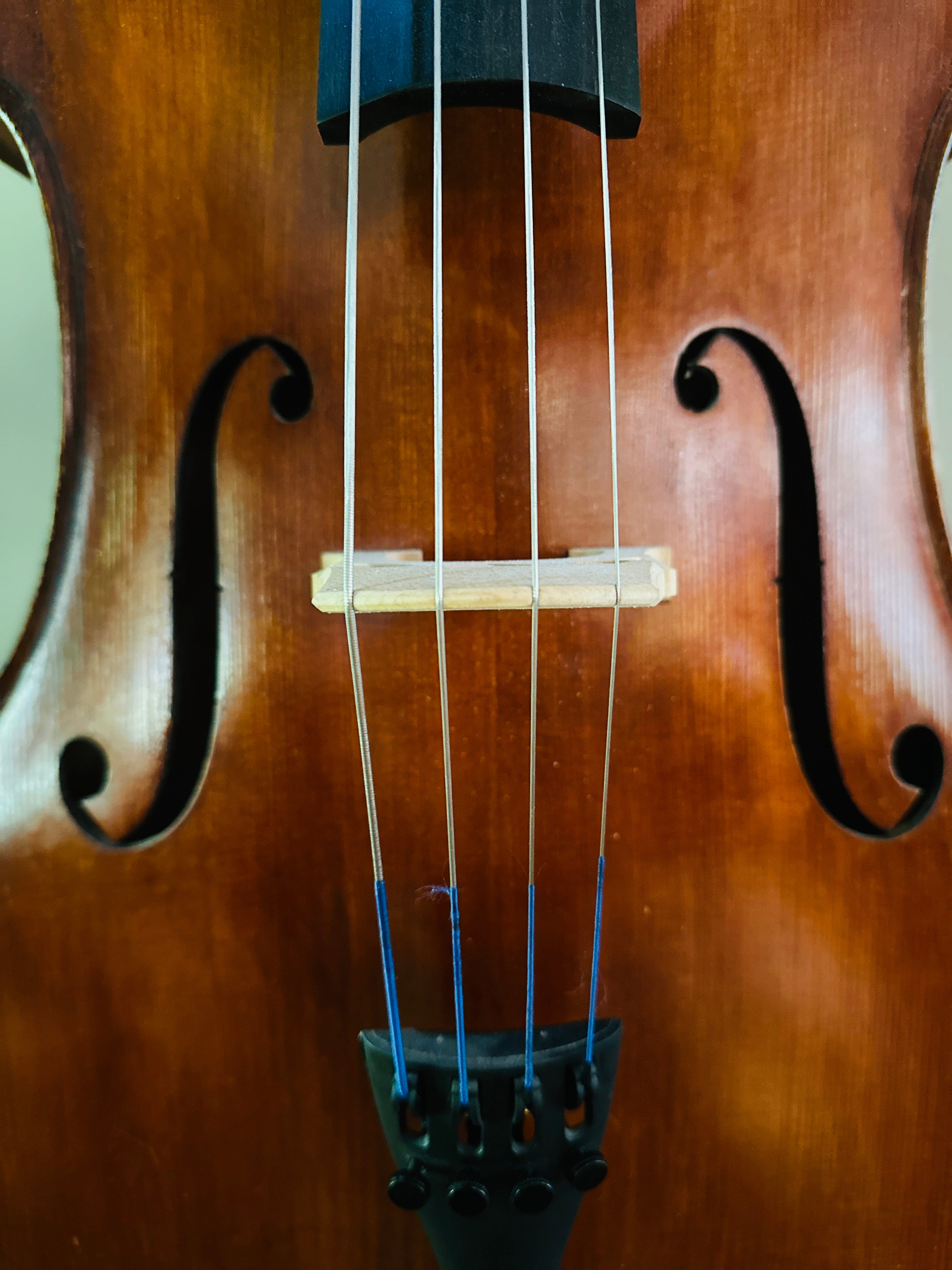
I am taking cello lessons again.
I say again because I took them years ago—I just looked it up, a decade ago—but I gave them up after my cello instructor, sitting very close to me in a tiny practice room, told me I had a “white aura, like Jesus,” and that she bet I could tell the future with some regularity. I wrote a check for that day’s lesson, but I felt like I was learning the wrong things.
Anyway, having turned in a very final draft of my next novel, I knew I would need something else I was bad at. For two years, I’ve been working away at this novel that is smarter than I am, studying continuously, practicing continuously, failing and trying again continuously, and I knew that I couldn’t just quit that kind of striving cold turkey. I have become accustomed to the overworked cycle of torment and reward. Without it, I would eat through walls.
So I found a new cello instructor, dusted off my cello, warned him that I really hadn’t ever been taught properly, and told him to be as cruel to me as necessary to establish good habits.
But CelloMan doesn’t want to be cruel. He doesn’t want to be discouraging. He would, however, really like me to stop doing that thing I am doing with the bow. Every lesson, I can see his optimism as I unpack my instrument and put my music on the stand and sit. And every week, I can see his mouth say “you’re doing well,” while his gaze says that he is experiencing the same level of anguish one feels when one first realizes, as a child, that parents will die one day. Each week, we have a version of the same conversation:
“That’s fine.”
“You can say what you’re really thinking!”
His eyes say, no, he can’t. He really can’t.
Now, I know the only way out is through. This isn’t my first instrument, or my first objectively complex skill; I know how practice works. And, as I’ve written before, I have a very high tolerance for it. For the Grind. For Drudgery. Everything worth doing requires it. As James Thurber says, “There is, of course, a certain amount of drudgery in newspaper work, just as there is in teaching classes, tunnelling into a bank, or being President of the United States.” Put in your ten thousand hours, receive prize.
I have been reading Atul Gawande’s COMPLICATIONS (it began as essays in The New Yorker; I didn’t mean to quote two writers from The New Yorker in one post), and ran across this:
There have now been studies of elite performers—international violinists, chess grand masters, professional ice-skaters, mathematicians, and so forth—and the biggest difference researchers find between them and lesser performers is the cumulative amount of practice they’ve had. Indeed, the most important talent may be the talent for practice itself. K. Anders Ericsson, a cognitive psychologist and expert on performance, notes that the most important way in which innate factors play a role may be in one’s willingness to engage in sustained training. He’s found, for example, that top performers dislike practicing just as much as others do. But more than others, they have the will to keep at it anyway.
Dutifully, no matter how I feel, no matter how busy I am, I set my timer and I put in at least thirty minutes of cello practice every single day. Last weekend, I hiked six hours in newly abusive summer heat, and then I drove three hours home and practiced before I went to bed. Yesterday, I knocked 300 fornicating Japanese Beetles off my roses into soapy water, and then, I came inside and did forty minutes of scales. Today, I’m going to write seven thousand words in various capacities, and then, I’ll rosin the bow and practice string crossings.
These days, in my forties, I’m a cynical sow about a lot of things, but I believe in practice.
But.
I now am very well aware that there is such a thing as bad practice. You might, for instance, take lessons from a woman who thinks you are literally the second coming, practice dutifully every day, and end up with a bow hold that makes CelloMan say “it’s fine” while looking as if he has just gotten shampoo in his mouth.
What we practice matters. You can put in ten thousand hours and end up with a lousy prize. It takes just as many hours to practice a lousy version of yourself as an amazing one. Understanding this, though, is the key to becoming great.
After reading that passage in Gawande, I looked up K. Anders Ericsson’s direct thoughts on the matter.
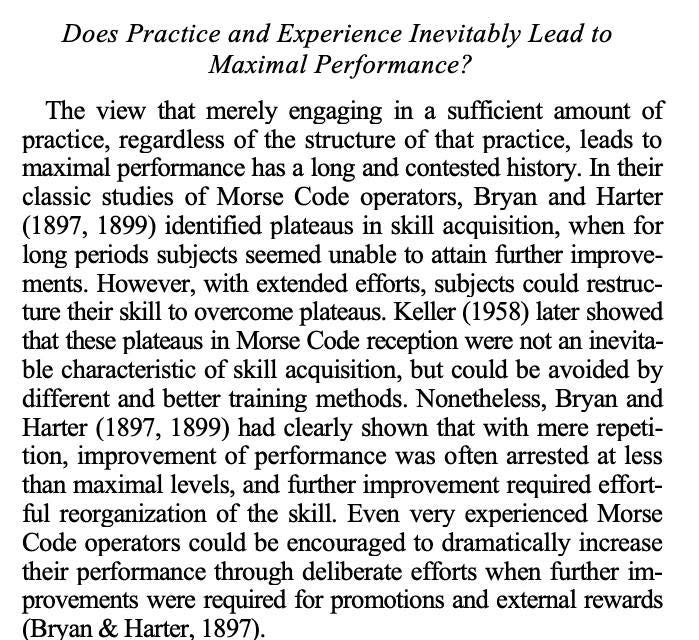
If I liked reading Gawande’s thoughts on practice, I loved reading this. Here, look at it again:
“With extended efforts, subject could restructure their skill to overcome plateaus.”
“Further improvement required effortful reorganization of the skill.”
Why do I love this? It underlines another central belief of mine: we can keep improving for our entire lives. Not just a little. A lot. Huge leaps and bounds at every age.
We have a cultural belief that our youth represents a narrow window of opportunity to be great, but the reality is more complicated. Sure, youth generally offers the best conditions for rapid, visible improvement (lots of free time, access to socially acceptable educational opportunities, lowest penalties for failure, big obvious gains in a short period of time because of relative inexperience at start, elastic brain parts). But motivated adults can master new skills, like a second language, with equal aplomb. Adults have already learned how to learn. And they can apply previous knowledge to new tasks. If they can find the time and create the structure, they can chain-bonus age and cunning to bigger and better things.
Ok, but can they be great? or just good?
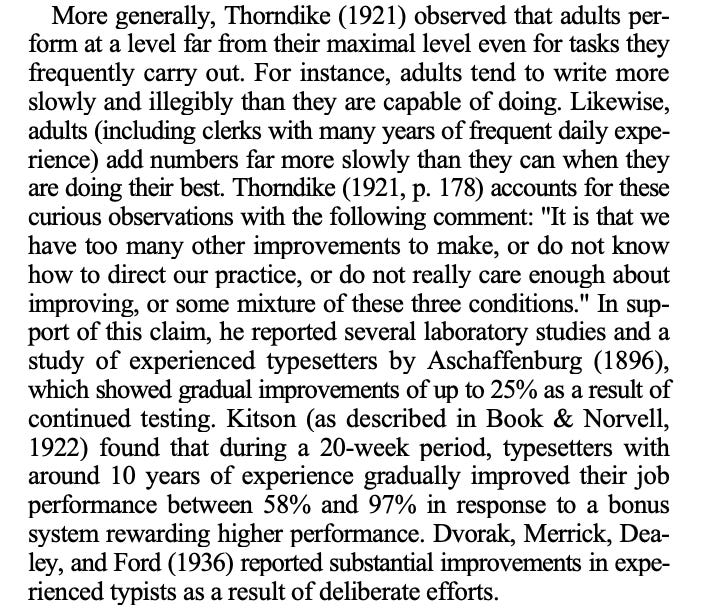
tl;dr, causes of plateauing skill:
We are overwhelmed by other parts of the task.
We don’t know how to focus our efforts.
It doesn’t matter enough to be worth the bandwidth.
So, to improve, we have to focus our efforts on bite-sized goals. And we have to want it.
For example, I wanted to get better at the cello. Specifically, I wanted better classical technique and precision (I am a folk musician at my core). So I hunted for a teacher known specifically for that . . . and throughout, I was honest with myself about whether I was willing to put in the time.
I’ve done this in my writing, too. I can say I want to improve with each novel, but without a focused goal, I’m not actually practicing. I’m just repeating the skill. I need to reorganize that practice with a new goal. Here’s some specific goals I’ve made for myself: After writing LAMENT, my debut novel, I decided to learn how to write about mythology in a more commercially accessible way—and you can see, I think, the difference between that novel and my use of myth in SHIVER. During my writing of the Shiver trilogy, I read SOMEDAY THIS PAIN WILL BE USEFUL TO YOU by Peter Cameron and decided: I want to only write characters that feel like real people, with a high level of specificity. I do not think it is too hard to see the effects of that practice by comparing the characters from the Shiver Trilogy to the ones in the Raven Cycle. And recently, after I finished THE LISTENERS, I decided I wanted to work on efficient, wry narration, and I spent the last several years reading and practicing.
(“Like this?” I ask.
“That’s fine,” says my editor’s mouth.
Her eyes, however, say that she is feeling like a person who picked up a cookie sheet with her bare hands only to realize it has not actually cooled to room temperature.
“I’ll do another pass through the manuscript,” I say.)
Now, if you’ll excuse me, I have to go practice. I have a lesson with CelloMan tomorrow.
Extras:
• I’m listening: “des fleurs” by Tove Lo & Stromae. “Bare (Redux)” by Wildes. “How Many Days Does it Take to Say Goodbye” by Parra for Cuva & Vines. (I still haven’t stopped listening to that new Death Cab, either).
• I’m reading: you guys remember when I wrote about cozy fiction? I found more.
• I’m doing: I think there are a few more spots for my Piccadilly Waterstones event next week, but I know there’s room if you’re coming to PYRKON in Poland. See ya there.

At (almost) 27, something I've noticed has improved with age is my ability to discern when I've hit a plateau from when I'm just being impatient for payoff. My tolerance for realistic drudgery timescales has extended, and I'm a lot more willing to endure six months of slow progress now than I was at 17. I think delayed gratification is more tolerable when the wait is a less significant slice of my total lifespan. Of course, I’ve also become I'm more attuned to the differences between slow but gradual progress and *stalled* progress, which also makes a difference. Learning how to learn, like you said.
Also: have you listened to the album "Palmless Prayer / Mass Murder Refrain" by MONO and world's end girlfriend? Part.2 is my favourite, but it's all pretty brilliant.
Maggie, do you remember what types of things you did to practice writing characters that feel like real people?