
Three Teachers
get me an old priest and a young priest and an inbetweeny one I guess

Teacher #1 & Teacher #2
“What do you do?” I asked.
I was being polite. Small-talky. It was a plane; we were going to be in close proximity for awhile. He had started it. Something-something-the-flight-is-going-well. Yup, sure. Come here often? etc. Normally, I’m a headphones on, head down sort of traveler, but he had that sort of face that wanted to be talked to.
“I teach at a university,” said the stranger-on-the-plane. “I teach [redacted].*
I asked, “Are you beloved?”
“What?” he asked, to be heard over the plane, who also wanted to be part of the conversation.
“Are you a beloved teacher?” I asked. “Also, are you effective? Either/or? Both/ and? Beloved or effective teacher? Beloved and effective teacher? Neither?”
I could tell he liked the question; he took his time considering it (the plane kept talking the entire time, but neither of us rewarded that kind of behavior). Eventually, he said, “I’ve gotten a teaching award* a few times in a row, so I think I’m effective, but I don’t know if I’m beloved. I’m not best friends with them. I make them work. But they seem to like me anyway.”
“I am not particularly nice to my students either,” I confessed. I did not tell him that I had made several students cry in multiple countries around the world. “But they seem to like me anyway, too.”
For a few minutes, we mused together, working out aloud if this was correlation, causation, or just the wind.
What we did conclude was that both of us valued practical application in our teaching, which was possibly why, at the very least, we got away with being less than snuggly. If you endured our instruction, you had stuff you could actually use in the real world.
I’m telling you this anecdote now so that you will know that I have your best interests at heart when I tell you, STOP ASKING ME ABOUT CHARACTER QUESTIONNAIRES.
*Later, he told me the university he worked for—this, plus the subject matter, was enough information for me to google him after we landed, which is how I discovered that the Wall Street Journal had declared him this particular extremely veritable institution’s most valuable faculty member (It would also be enough information for you to google him, so I’m not going to give you either piece of information)**
**later, later, when we exchanged emails, I told him how charmed I was by his modesty/reticence.***
***I suppose it was true that, when he asked what I did, I just said “I’ve written some books.”
An interlude of mostly complaining
MY GOD. Character questionnaires. If I had a dime for every time I was asked about them, I could add guac to all my Chipotle orders. What are they? If you want a real example, you can duckduckgo “Sample character questionnaire.” When I think about them for too long, I get mad, then I get depressed, and then I black out. All I will tell you here is that they involve a bunch of questions you’re supposed to answer about your novel’s characters, like, what are their hobbies, do they have siblings, are their eyes a piercing green.
;a;ijlbh. ‘a
Sorry, I got mad, then depressed, and then I blacked out on my keyboard.
Ok, I’m focused
And I’m telling you why I don’t like them: they give the wrong kind of information, at least if you’re writing a Stiefvater character. They tell you everything about a person except what you’d need to know.
Let’s bring in teacher #3.
Teacher #3
Lately, as part of my make-my-brain-a-better-listener goal, I’ve been listening to interviews and lectures while I’m doing my daily hell-stint on the rowing machine. Currently on the docket are the Richard Feynman lectures. For those not in the know, he was a dynamite celebrity theoretical physicist known a little for his work on the Manhattan project, a little more for his Nobel for quantum electrodynamics, and lot for his charismatic and humorous personality.
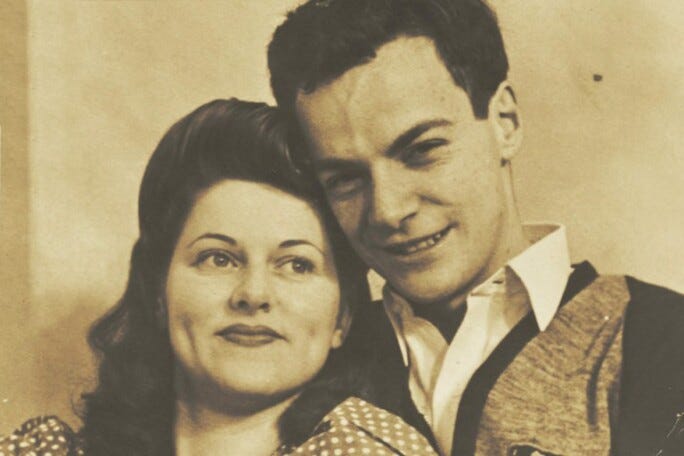
[His high school sweetheart’s] death tipped him into years of nihilism and depression; although, as Bethe remarked, “Feynman depressed is just a little more cheerful than any other person when he is exuberant.”
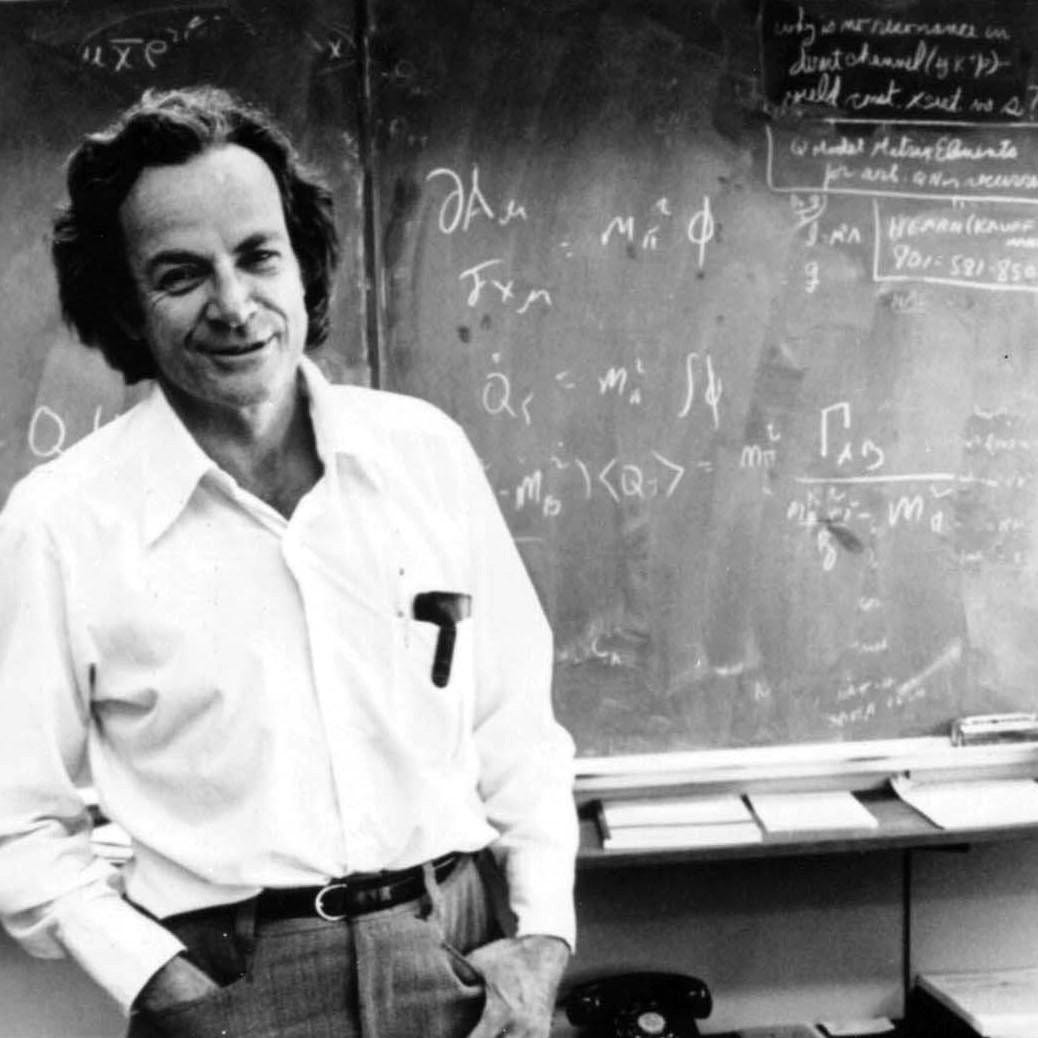
The story goes that Caltech wanted to update their Intro to Physics course and asked Feynman, already a celebrity faculty member, if he’d do it. To their surprise, he agreed, although he said he would teach it only once. Caltech knew they were on to something good, so they recorded the lectures from the beginning. By the end of the two years, the undergrads in the audience were outnumbered by grad students and faculty, coming to listen. I think they’re now more widely consumed in their edited textbook form (available for free here), but I don’t have time to add introductory physics texts to my to-be-read pile and I do have a need to put something in my ears while hatefully rowing, so here we are. And to be honest, I’m glad: Feynman is at his most compelling in spoken form.
Now, I’m not dragging Feynman into this for his teaching style. I’m dragging him in as a character.
As I was listening and rowing, I was thinking: what information would I need to build a Feynman into a novel (not the Feynman. A person like Feynman. A Feynman)? Why was I thinking this? Probably because his personality is so famous. Dismantling it was professional curiosity.
Rowing along, I thought to myself how I learned something about him when he presented smoothly and confidently, tackling his subject matter with obvious ease.
I also thought about how I learned something else, though, when he had to correct himself. In one early lecture, he began to give an example and then didn’t like it. There was information about him in the fact that he restarted, how he carried himself in the pause, how long he allowed himself to think, and what the second example did better (if it was better).
I also thought how I learned something else again when his voice changed for just an instant—oh! this is his lecture voice, a public speaking voice, which means there is a real voice, or at least a different voice for other occasions, and presumably, a different him.
I learned something in how he begins and ends his lectures, how he addresses the students (“Gentlemen!”)(this is Intro to Physics in 1961; there are no women). Does he address the faculty ever? I don’t know yet. Does a student ever ask a question? I would learn yet more if they did, because personality is only evident when it is demonstrated on something or someone else.
There are other, inner piece of information that I would like to know, if I was building a Feynman: What is he thinking as he is presenting, is he pleased with the result? Is he glad he is only doing this once? When they tell him they are recording history, does he agree? All of these and a thousand other hard-to-articulate pieces of information go into building a character in a Stiefvater novel.
But more important than any of these questions are the questions I have not about Feynman-the-Character, but rather, the questions I have for the novel itself: what is the purpose of this novel? What is the mood I want to leave the reader in? Why am I writing it?
Because everything I need to know about the character is subservient to those answers. Character is subtractive, which means you start with a real person, and you take away fuzz and noise until you have a clearly usable narrative device. Feynman, the reality, doesn’t work as a character. Feynman must be edited, stylized, purpose-built. (i.e., If I was writing a love story, I would need more questions answered by this Feynman. If I were writing a comedy, it would be this one. In the end, Feynman-the-Character would be sleek and fractional; if he wasn’t, I have written a biography, and a very good one at that, since even biographies tend to have points of view.)
Back to my complaining
Character questionnaires encourage you to start with the very fuzz and noise I’m talking about editing out. And if you added enough fuzz and noise back again, eventually you end up with a character who is just as unprioritized and complex as a human. . . which means you’re actually just as far away from getting your chapters done as you were before you had any character at all.
So what’s the answer?
You need to ask yourself what kinds of characters you like to read and then build a system that makes sense to you for creating them. There are as many different ways of doing this as there are brains. But will it be a questionnaire that includes eye color? I bet not.

Extras
• I’m listening: “Want You to Love” by Son Lux
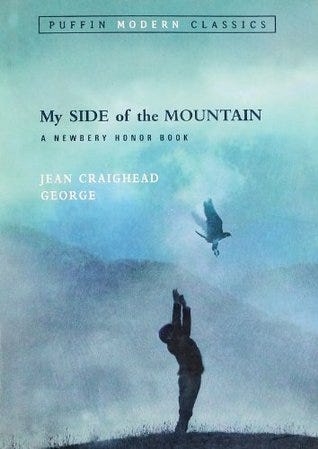
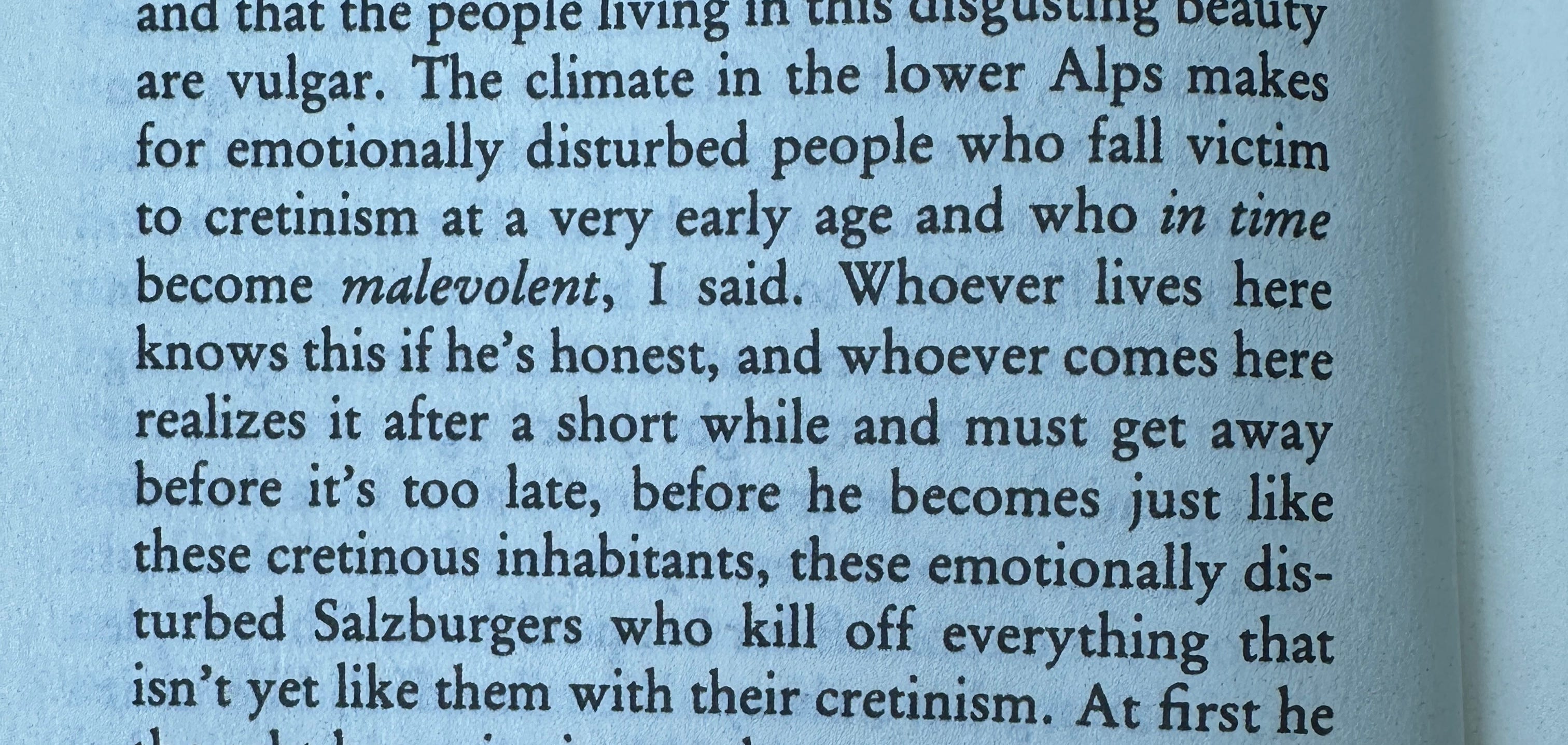
• I’m reading: I LIVE UNDERWATER, by Max Gene Nohl, THE LOSER, by Thomas Bernhard, and re-reading MY SIDE OF THE MOUNTAIN, by Jean Craighead George.
Just got back from a reunion of 6 of those original tortured students in another Scottish estate house. Less crying, but lots of writing.
Was not expecting a MtG cameo. I like the way stranger-on-a-plane described his teaching style. In the long term, the teachers I've appreciated the most are those who left me with applicable skills, even if it required more (and harder) work during the class/seminar/torture castle stay. It left me feeling like there was a purpose to the struggle beyond "pass this class", and I can continue to use and sharpen the skills on my own.