
Writer Toolbox: Iterative Drafting, Part 2
let's spend some time in the kitchen

Last week, I shared Edwin Austin Abbey’s preparatory pieces for his painting “Richard, Duke of Gloucester, and the Lady Anne” so that we could talk about the process of iterative drafting—hold on, I just realized I’m wearing my hoodie inside out.
Okay, I’m back.
Right, anyway, you can read that part one here.
In short: creators across many media work iteratively to create sophisticated, large-scale works, but it’s not always easy to see the process from the outside. Because painting is a visual medium, we can watch Abbey cycle through options and practice different priorities for his piece.
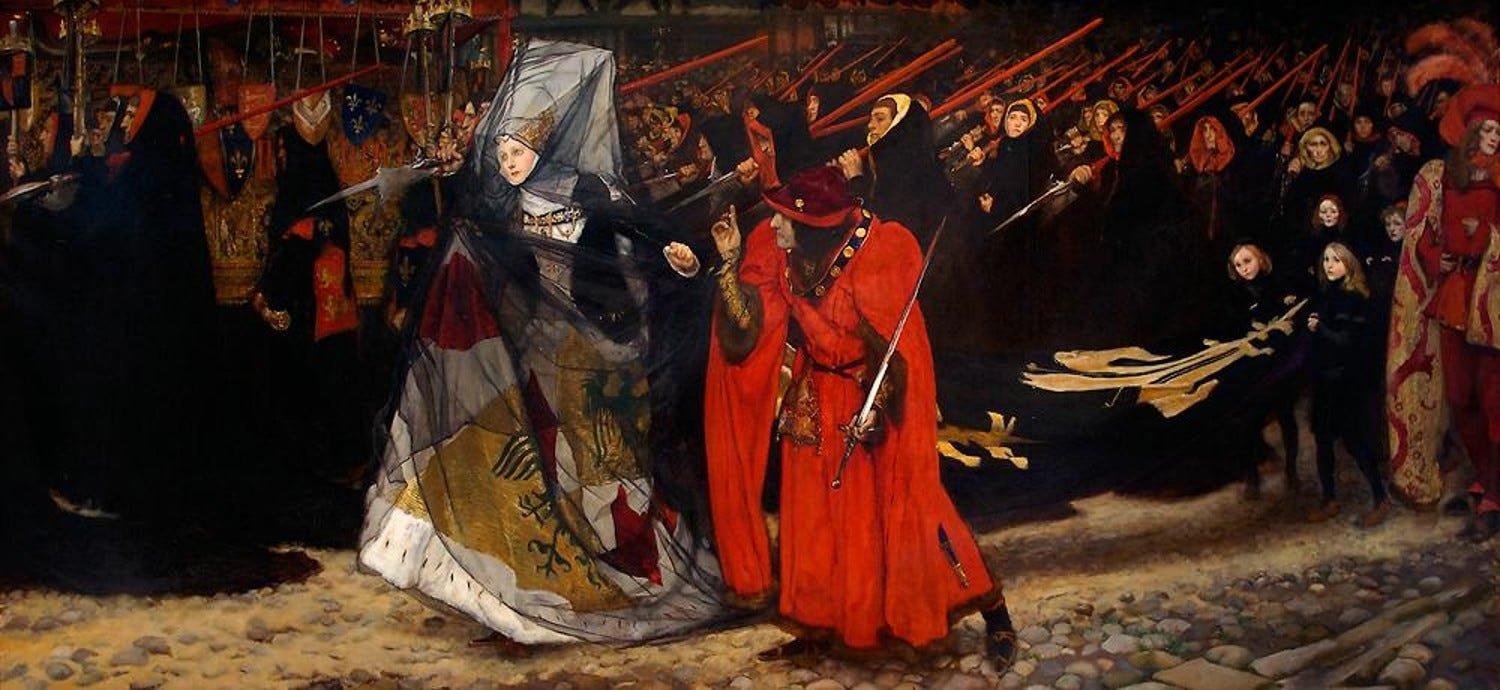
Last week, I promised I would source examples of my own iterative process. Me, doing in words, what Abbey was doing with pigment. Both of us throwing ourselves repeatedly at an artistic puzzle, using variations to hone our solutions.
I’m gonna warn you up front: my example is flawed.
It’s easy to take in Abbey’s final piece all in one look. That means it’s also easy to see how each of his variations altered the whole. That’s what made it a great shorthand.
We can’t take in an entire novel in a single glance. That means that it’ll be far less easy to understand someone’s chapter variations in the same way. The reasoning behind some of my experiments will be obvious within the chapter, but some of the variations were experimenting with solving other parts of the draft. You’d have to read ten full manuscripts to understand them in the same way as Abbey’s variations.
My God. We’re not doing that.
So I did my best to find a discreet piece of writing that showed off my iterative process while not requiring a lot of context. Just know it’s not going to be as elegant as the visual work-in-progress snapshot Abbey’s visual example.
I selected a scene that persisted through each draft of THE LISTENERS. For those of you who don’t know, it’s a lightly speculative historical novel about a real moment in history, when the State Department tapped a half a dozen or so rural luxury hotels to temporarily house the Axis diplomats still in the States when World War II began. It follows June Hudson, the manager of The Avallon, as her slightly uncanny hotel is pressed into service.
As I started drafting, I knew that one of the major challenges these managers faced was maintaining control of their staff; asking them to serve Nazis with a smile was a tall order as the war began for America. From the beginning, this scene, where her chef is tantruming, felt like it should be a linchpin or an exemplar or a culmination or a beginning of her problems in this department.
I’m going to share ten versions of it, starting with the one that made it through to the line edit at the end (so, the closest to the “finished painting.”) Then I’m going to count backwards, until #1 represents the very first time I took a whack at it.
Most of the changes are pretty unsubtle, but if you want to skim through them fast, here’s a tip: look at the beginnings and the ends. Those are always the thesis statements. And always keep in mind my caveat: this is a flawed example, because it is partial. It was not just these scene changing with each variation. The rest of the draft was also iterating with each pass, meaning this chapter sometimes appeared at page 40, sometimes at 170. Sometimes it was a reaction to a big moment; sometimes it was the big moment. Sometimes it was the question; sometimes it was the answer. This is what iteration is: being willing to try wildly different solutions to see what they do.
10 (most final)

9
8
7
6
5
4
3
2
1 (least final)
Well, that’s a lot of cheffing. Was that useful? Do you have questions? Let me know.
Extras
• I’m listening: “How Heavenly a State,” off the new Death Cab for Cutie, which becomes so madly transcendent halfway through that I lose my mind each time.
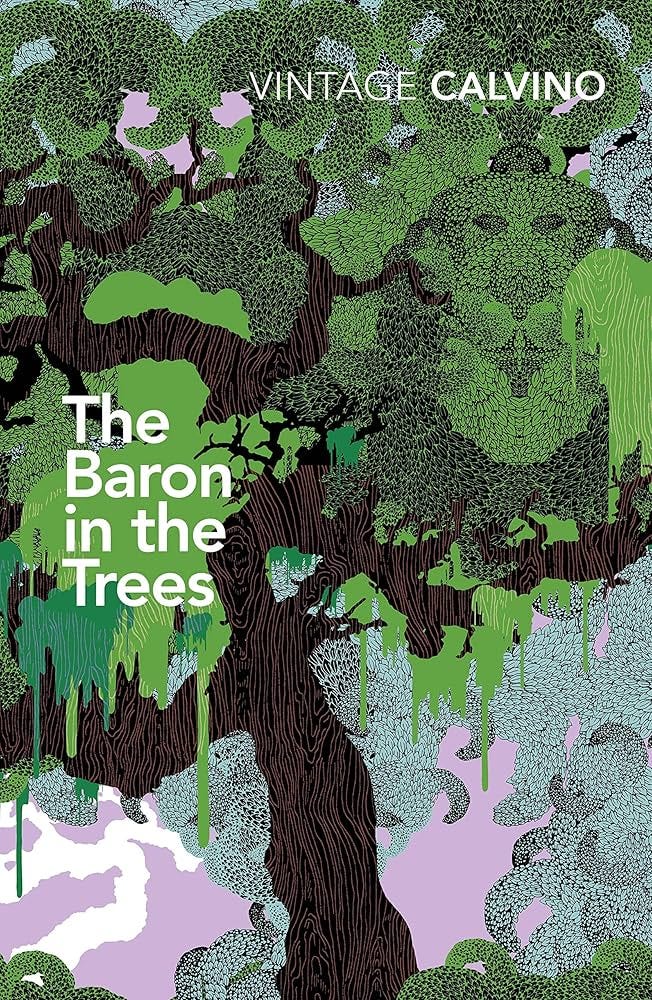
•I’m reading: The Baron in the Trees, by Italo Calvino, which, nearly 70 years after its release, is getting made into a film. Lately, I’ve been so pleased by novels in translation that I asked readers if they would recommend some to me. You can see their recommendations on X, Threads, Bluesky, Facebook, and here on Substack.
• I’m watching: someone doing a modified Button-Bentall operation to replace an aortic root (not gonna embed that video, in honor of the squeamish).
• I’m doing: making a gluten-free sourdough starter, giving it a test-drive, driving to some Virginia trailheads, giving nature a test-drive.


Nice! I'll go out on a limb and say I think I see the evolution of the scene from something that's more than an outline but less than a draft to the finished product. The first scene looks like it's halfway between outline and first draft, trying to see what you have to say. It's a little scattershot, as if you haven't quite figured Fortéscue's character or his relationship with June yet. I see a little flailing in the early versions as if you're playing with ideas trying to find the heart of the scene. Fortéscue becomes more sympathetic and June softer in her dealings with him. It begins to resemble the final. Most of the elements are there in #8. In the final, you zoom in and crop tightly until you've cut away everything that isn't Fortéscue. At that point, he stands for the entirety of the Avallon 's staff and the scene can be boiled down to June dealing with the "I don't want to serve these people." BTW—I was surprised by how much changing the enumeration of ingredients from a list to the text improved the flow.
I really appreciated this since editing is always a shadowy beast for me, hard to wrangle. As I worked backwards I could hear the discordant notes: where the voice wasn't quite the June we know in the finished product, adverbs snagging at the flow, so much more explicit than implicit. I've been thinking a lot about the external (who what when where) and internal (why) in a scene and how both can be shifted and moved around until they balance each other out. I tend to tangle my plot, making it more difficult to shift individual pieces.
I know changes like this don't happen in a vacuum, do you make a change and then work through the entire draft to see how it ripples out? Do you move one scene around until it finds its home, banging its elbows on the neighboring scenes as it goes?
Unrelated: if you ever have any inclination to chat about writing/making art while also raising kids, I would take any advice/pep you have to offer (and I hope others would too)